Showing posts with label Reptiles. Show all posts

Cobra Snake

Wednesday, 6 February 2013

Cobra Snake: The king cobra is the world’s largest venomous snake, with an average length of 12 feet but known to grow up to 18.5 feet. While it preys chiefly on other snakes, the king cobra is highly aggressive, extremely fast and agile, and injects a larger amount of venom per bite (as much as 600 mg) than most snakes. The king cobra is unique among snakes as it makes a nest for its eggs and remains until the young hatch. An adult human can die from a single bite in less than 15 minutes, making the king cobra one of the most feared and deadly snakes in the world.

The other cobra of Asia is known as Asian, Indian or Spectacled cobra due to the eyeglass-shaped pattern on its skin. The hood of the Asian cobra is larger than that of king cobra and is usually yellow or brown with a black and white spectacle pattern on top and two black and white spots on the lower surface. The Ringhals, a different type of spitting cobra confined to southern Africa, are the smallest, reaching only about 4 feet in length. It is dark brown or black with ridged, or keeled, scales and light rings on the neck.

 Cobra Snake
 Cobra Snake
 Cobra Snake
Cobra Snake
Read more ...

Black Mamba

Tuesday, 22 January 2013

Black Mamba: also called the common black mamba or black-mouthed mamba, is the longest venomous snake in Africa, averaging around 2.5 to 3.2 m (8.2 to 10 ft) in length, and sometimes growing to lengths of 4.45 m (14.6 ft). It is named for the black colour of the inside of the mouth rather than the colour of its scales which varies from dull yellowish-green to a gun-metal grey. It is the fastest snake in the world, capable of moving at 4.32 to 5.4 metres per second (16–20 km/h, 10–12 mph).

It has a reputation for being aggressive and highly venomous and is among the world's most venomous land snakes based on murine LD50 in a study. The black mamba was first described in 1864 by Albert Günther, a German-born British zoologist, ichthyologist, and herpetologist. Soon after, a subspecies was identified, Dendroaspis polylepis antinorii (Peters, 1873), but this is no longer accepted as distinct. The genus and species name are derived from Ancient Greek words Dendroaspis.

 Black Mamba
 Black Mamba
 Black Mamba
Black Mamba
Read more ...

Milk Snake

Friday, 18 January 2013

Milk Snake: Lampropeltis triangulum, commonly known as a milk snake or milksnake, (French: Couleuvre tachetée; Spanish: Culebra-real coralillo) is a species of king snake. There are 24 subspecies of milk snakes. Lampropeltis elapsoides, the scarlet kingsnake, was formerly classified as the subspecies L. t. elapsoides, but is now recognized as a distinct species. The subspecies have strikingly different appearances, and many of them have their own common names.

Milk snakes grow 20 to 60 inches (51 to 150 cm) long. They have smooth and shiny scales and their typical color pattern is alternating bands of red-black-yellow or white-black-red. However, red blotches instead of bands are seen in some populations. Some milk snakes have a striking resemblance to coral snakes and this mimicry (known as Batesian mimicry) likely scares away potential predators. While both milk snakes and coral snakes possess transverse bands of red, black and yello

 Milk Snake
 Milk Snake
 Milk Snake
Milk Snake
Read more ...

Agama Agama

Tuesday, 25 December 2012

Agama Agama: An agama is any one of the various small, long-tailed, insect-eating lizards of the genus Agama. The agamid genus is composed of at least 37 species across Africa, where they are the most common lizard. They can be found in many sizes, from 12.5 to 30 cm (5 in. to 1 ft.) in length and a wide variety of colours. One of the best known species is the Agama agama, widespread in sub-Saharan Africa. For Eurasian agamas, see the genus Laudakia.

Agamas originally lived in forest and bush across Africa, but have since adapted to live in villages and compounds where their habitat has been cleared. They live inside the thatch of huts and other small spaces, emerging only to feed. If caught out in the open, agamas are able to run quickly on their hind legs to reach shelter. The desert agama can still be found in the dry areas of North Africa. Despite their name, they avoid bare sand. See Pictures of Agama Agama below.

 Agama Agama
 Agama Agama
 Agama Agama
Agama Agama
Read more ...

King Cobra

Monday, 17 December 2012

King Cobra: (Ophiophagus hannah) is the world's longest venomous snake, with a length up to 5.6 m (18.5 ft). This species, which preys chiefly on other snakes, is found predominantly in forests from India through Southeast Asia to Indonesia and the Philippines. Despite the word "cobra" in its name, this snake is not a member of Naja ("true cobras") but belongs to its own genus. The king cobra is considered to be a very dangerous snake. It has cultural significance as well.

The king cobra averages at 3 to 4 m (9.8 to 13 ft) in length and typically weighs about 6 kg (13 lb). This species is more slender than the Eastern Diamondback Rattlesnake and the Gaboon Viper, who compete for the title of the heaviest venomous snake, but at average sizes, it is much longer and will weigh approximately the same as the two bulky vipers. The longest known specimen was kept captive at the London Zoo, and grew to around 18.5 to 18.8 ft (5.6 to 5.7 m) before being euthanised upon the outbreak of World War II.

 King Cobra
 King Cobra
 King Cobra
 King Cobra
Read more ...

Monitor Lizard

Tuesday, 13 November 2012

Monitor Lizard:  Monitor lizards are generally large reptiles, although some can be as small as 20 centimetres (7.9 in) in length. They have long necks, powerful tails and claws, and well-developed limbs. Most species are terrestrial, but arboreal and semiaquatic monitors are also known. Almost all monitor lizards are carnivorous, although Varanus bitatawa, Varanus mabitang and Varanus olivaceus are also known to eat fruit.

 They are oviparous, laying from seven to 37 eggs, which they often cover with soil or protect in a hollow tree stump. The various species of Varanus cover a vast area, occurring through Africa, the Indian subcontinent from Pakistan, India and Sri Lanka to China, down Southeast Asia to Indonesia, the Philippines, New Guinea, Australia and islands of the Indian Ocean, and South China Sea. There is also a large concentration of monitor lizards in Tioman Island in the Malaysian state of Pahang.

 Monitor Lizard
 Monitor Lizard
 Monitor Lizard
Monitor Lizard
Read more ...

Radiated Tortoise

Monday, 8 October 2012

Radiated Tortoise:  The radiated tortoise (Astrochelys radiata) is a species in the family Testudinidae. Although this species is native to and most abundant in southern Madagascar, it can be also be found in the rest of this island, and has been introduced to the islands of Réunion and Mauritius. As the Radiated Tortoises are herbivores, grazing constitutes 80-90% of their diet, while they also eat fruits and succulent plants. A favorite food in the wild is the Opuntia cactus. They are known to graze regularly in the same area, thus keeping the vegetation in that area closely trimmed. 

They seem to prefer new growth rather than mature growth because of the high-protein, low-fiber content. These tortoises are, however, endangered, mainly because of the destruction of their habitat by humans and because of poaching. The oldest radiated tortoise ever recorded was Tu'i Malila, who died at an estimated age of 188, the oldest tortoise being Adwaita. Growing to a carapace length of up to 16 inches (41 centimeters) and weighing up to 35 pounds (16 kg), the radiated tortoise is considered to be one of the world's most beautiful tortoises.

 Radiated Tortoise
 Radiated Tortoise
 Radiated Tortoise
 Radiated Tortoise

Read more ...

Yellow-Spotted River Turtle

Monday, 17 September 2012

Yellow-Spotted River Turtle:  The Yellow-spotted Amazon River Turtle or Yellow-spotted River Turtle (Podocnemis unifilis) is one of the largest South American river turtles. It can grow up to 45 cm long and weigh up to 8 kg. This species can be recognized by its black or brown oval carapace (upper shell) with distinctive low keels on the second and third scutes. Yellow spots on the side of its head give this species its common name. These spots are most prominent in juveniles and fade with age. Females can be up to twice the size of males.

These turtles are found in tributaries and large lakes of South America's Amazon Basin. During flood season, they may venture into flooded forests or floodplain lakes. They feed on fruits, weeds, fish, and small invertebrates. The females lay two clutches of eggs each year, each with 4 to 35 eggs in it. They make their nests in sandy areas on the banks of rivers where the eggs will hatch 66 to 159 days after they are laid. The eggs are laid at the peak of dry season so that the nest will not be washed away with the floods of the rainy season. The average life span is 60 to 70 years.

 Yellow-Spotted River Turtle
 Yellow-Spotted River Turtle
 Yellow-Spotted River Turtle
 Yellow-Spotted River Turtle
Read more ...

Sand Lizard

Saturday, 15 September 2012

Sand Lizard:  The sand lizard (Lacerta agilis) is a lacertid lizard distributed across most of Europe and eastwards to Mongolia. It does not occur in the Iberian peninsula or European Turkey. Its distribution is often patchy. The sand lizard has a light underbelly and a dorsal stripe: males tend to be darker in colour and turn partly or wholly bright green during the mating season. Sand lizards can reach up to 25 cm (10 in) in length.

 It has several subspecies, the westernmost of which is Lacerta agilis agilis. In this and the other main western subspecies (L. a. argus), the dorsal stripe is thin and interrupted, or not present at all.  This applies particularly to the latter subspecies, which also includes a plain red or brown-backed phase without any dorsal markings. In these two subspecies, only the flanks of the males turn green in the mating season, but in the eastern subspecies (predominantly L. a. exigua), males can be wholly green, even outside the breeding season. 

 Sand Lizard
 Sand Lizard
 Sand Lizard
 Sand Lizard
Read more ...

Leafy Sea Dragon

Monday, 10 September 2012

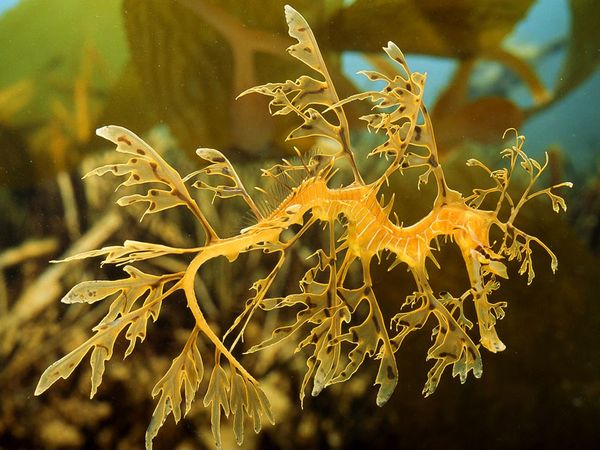
Leafy Sea Dragon:  The leafy seadragon or Glauert's seadragon, Phycodurus eques, is a marine fish in the family Syngnathidae, which also includes the seahorses. It is the only member of the genus Phycodurus. It is found along the southern and western coasts of Australia. The name is derived from the appearance, with long leaf-like protrusions coming from all over the body. These protrusions are not used for propulsion; they serve only as camouflage. The leafy seadragon propels itself by means of a pectoral fin on the ridge of its neck and a dorsal fin on its back closer to the tail end.

These small fins are almost completely transparent and difficult to see as they undulate minutely to move the creature sedately through the water, completing the illusion of floating seaweed. Popularly known as "leafies", they are the marine emblem of the state of South Australia and a focus for local marine conservation. Much like the seahorse, the leafy seadragon's name is derived from its resemblance to another creature (in this case, the mythical dragon). While not large, they are slightly larger than most seahorses, growing to about 20–24 cm (8–10 in). They feed on plankton and small crustaceans.

 Leafy Sea Dragon
 Leafy Sea Dragon
 Leafy Sea Dragon
 Leafy Sea Dragon
Read more ...

Sea Turtle

Monday, 3 September 2012

Sea Turtle:  Sea turtles (superfamily Chelonioidea) are marine reptiles that inhabit all of the world's oceans except the Arctic. The superfamily Chelonioidea has a world-wide distribution; sea turtles can be found in all oceans except for the polar regions. Some species travel between oceans. The flatback sea turtle is found solely on the northern coast of Australia. A green sea turtle breaks the surface to breathe. Sea turtles are almost always submerged, and, therefore, have developed an anaerobic system of energy metabolism. Although all sea turtles breathe air, under dire circumstances they may divert to anaerobic metabolism for long periods of time.

 When surfacing to breathe, a sea turtle can quickly refill its lungs with a single explosive exhalation and rapid inhalation. Their large lungs have adapted to permit rapid exchange of oxygen and to avoid trapping gases during deep dives. According to SeaWorld Parks & Entertainment, a lifespan of 80 years is feasible for sea turtles. It takes decades for sea turtles to reach sexual maturity. After mating at sea, adult female sea turtles return to land to nest at night. Different species of sea turtles exhibit various levels of philopatry. In the extreme case, females return to the beach where they hatched. This can take place every two to four years in maturity. They make from one to eight nests per season.


 Sea Turtle
 Sea Turtle
 Sea Turtle
 Sea Turtle
Read more ...

Snake

Monday, 20 August 2012

Snake:  Snakes are elongate, legless, carnivorous reptiles of the suborder Serpentes that can be distinguished from legless lizards by their lack of eyelids and external ears. Like all squamates, snakes are ectothermic, amniote vertebrates covered in overlapping scales. Many species of snakes have skulls with many more joints than their lizard ancestors, enabling them to swallow prey much larger than their heads with their highly mobile jaws. To accommodate their narrow bodies, snakes' paired organs (such as kidneys) appear one in front of the other instead of side by side, and most have only one functional lung. Some species retain a pelvic girdle with a pair of vestigial claws on either side of the cloaca.

Living snakes are found on every continent except Antarctica, in the Pacific and Indian Oceans, and on most smaller land masses — exceptions include some large islands, such as Ireland and New Zealand, and many small islands of the Atlantic and central Pacific. More than 20 families are currently recognized, comprising about 500 genera and about 3,400 species. They range in size from the tiny, 10 cm-long thread snake to the Reticulated python of up to 8.7 meters (29 ft) in length. The fossil species Titanoboa cerrejonensis was 15 meters (49 ft) long. Snakes are thought to have evolved from either burrowing or aquatic lizards during the mid-Cretaceous period, and the earliest known fossils date to around 112 Ma ago.

 Snake
 Snake
 Snake
Snake
Read more ...

Snapping Turtle

Snapping Turtle:  The common snapping turtle (Chelydra serpentina) is a large freshwater turtle of the family Chelydridae. Its natural range extends from southeastern Canada, southwest to the edge of the Rocky Mountains, as far east as Nova Scotia and Florida and as far southwest as northeastern Mexico. This species and the larger alligator snapping turtle are the only two species in this family found in North America.

Common snappers are noted for their belligerent disposition when out of the water, their powerful beak-like jaws, and their highly mobile head and neck (hence the specific name "serpentina", meaning "snake-like"). In some areas they are hunted very heavily for their meat, a popular ingredient in turtle soup. These turtles have lived for up to 47 years in captivity, while the lifespan of wild individuals is estimated to be around 30 years.

  Snapping Turtle
  Snapping Turtle
  Snapping Turtle
 Snapping Turtle
Read more ...
 

Sponsored Links